


Lower School
Grade 2
In second grade students explore their own character and interests. In Language Arts they begin to read chapter books together and develop key analytical comprehension skills as they discuss the books. In math, students begin to build basic operations, eventually applying that understanding to fractions and decimals. In science, students are encouraged to develop a sense of wonder and curiosity about the world around them through the study of topics like the natural landscape of the MCDS prairie and the motion of the planetary objects.
Second Grade Curriculum:
Language Arts
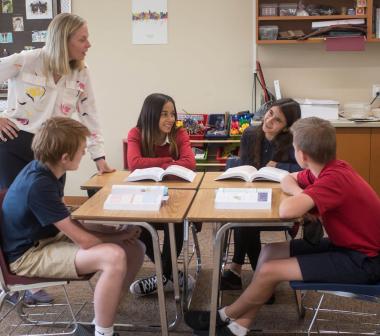
Through the Logic of English curriculum, students learn spelling rules and phonograms to build a foundation for more complex reading and writing. Grammar skills, including punctuation, capitalization, compound words, antonyms, synonyms, homonyms, and contractions are taught. Second grade students write independently in journals, responding to topics related to the Unit of Inquiry. Throughout the school year, students write in a wide variety of genres, such as narrative, nonfiction reports, letters, fairy tales, and poetry. Students practice reading fluency with a mix of listening to reading, partner reading, and independent reading. In addition, students read and discuss books as a whole class.
Math
In the Singapore Math program, basic concepts introduced in first grade extend to reading and writing numbers through 100s both in digits and in words, adding and subtracting to 1,000 without renaming, and completing those operations with renaming. Topics covered this year include standard and metric measurement, multiplication and division through 5s, money, time, geometric shapes, graphing, and area of simple figures, with extensive practice with word problems.
History and Geography
History and geography is explored through inquiry and the Primary Years Program units. Students learn about Greek and Roman ancient civilizations, the Middle Ages, the religion of Islam, and the tribes of Ancient Africa through the themes of art, language, social structure, religion, and technology. Students build their background knowledge and make connections with history through discussion, the sharing of related picture books, projects, mapping, and writing assignments.
Art
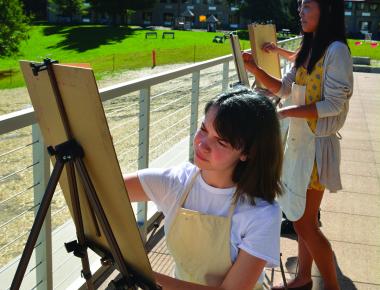
Students review color, line and shape while they study sculpture and architecture for symmetry and balance. They also study depth, perspective, light and shadow in two-dimensional artworks. They also look at children’s book illustrations and create works in the style of an illustrator. Making clay sculptures and examining topics and activities to complement other class subjects, such as Greek mythology, may be added.
Music
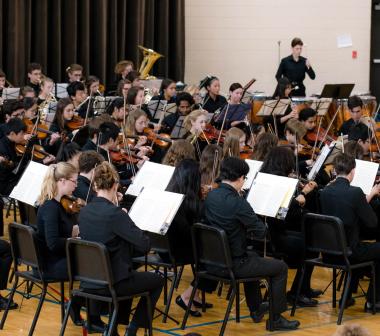
Students begin a broad introduction to the Baroque and Classical periods in music history, studying composers, styles, and forms of music, and listening to many musical examples. Students continue with weekly piano lessons, applying an expanded understanding of musical concepts learned in the music classroom, such as greater attention to articulation, dynamics and form as well as rhythm and pitch. Classroom activities include singing, movement exploration including circle dances, playing instruments, and music games. Reading and writing musical notation expands to include a wider range of notes, rhythms, additional symbols, and vocabulary. This year, students learn to identify instruments in each of the four orchestra instrument families and are introduced to more excerpts of orchestral music and some of the composers who wrote them.
Science
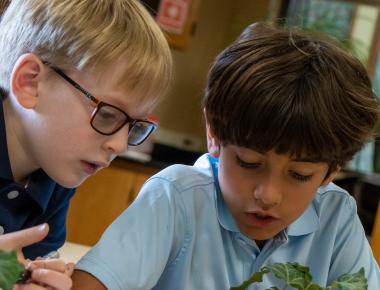
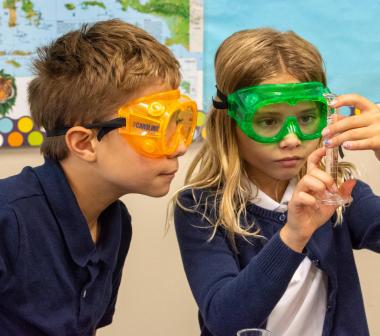
Students in second grade continue to nurture a sense of wonder and curiosity about the world while developing a more concrete sense of the process of experimentation. They learn to hypothesize, observe and study the results of their experiments while utilizing the campus environment to study structural adaptations of plants and animals in a variety of ecosystems. Second graders compare and contrast the moon and the earth, looking at size, rotation and revolution differences. Students also discover how earth’s landforms are shaped over time through the movements of earth’s plates and erosion.
Spanish
Second grade continues to build vocabulary and begins to study sentence construction. Emphasis on building vocabulary uses children’s poetry, songs, and role playing. Topics include a review of first grade material, the alphabet, numbers, the house and house furnishings, entertainment, seasons and activities, food, restaurants and table settings, likes and dislikes, school subjects, instruments, adjectives, buildings, the zoo, and prepositions. Throughout the year, students enjoy learning about the various cultures and regions of the Spanish-speaking world, including units on Cinco de Mayo, Día de los Muertos and Christmas celebrations while they develop competency in speaking, listening, reading, and writing.
Physical Education
The program emphasizes physical skills that can be applied in multiple sports situations. Through games and drills, students learn basic skill development, fine and gross motor movements, spatial awareness and basic strategy. Students develop confidence and motivation to participate in organized and individual physical activities. Learning leadership, teamwork and good sportsmanship also emphasizes lifelong fitness.
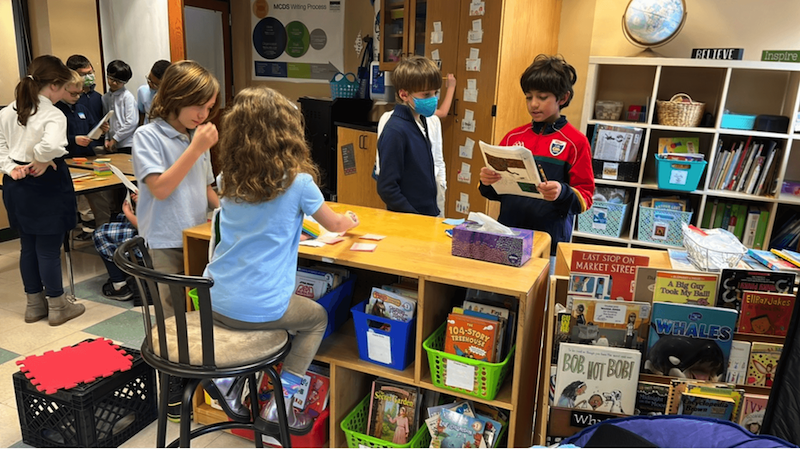
Our Curriculum in Action:
During the second grade unit on Sharing the Planet, students learned about animal adaptations and habitats. Students learned about nonfiction features and used nonfiction books to learn more about an animal. Then, each student completed their own animal research book, as well as a clay tile designed in art class to depict the animal in its habitat. Each second grade student set up a museum exhibit to display their research and art. Third grade students visited the museum so that students can teach others about the animal they researched!